Categories
General Healthcare News

Supreme Court Blocks Vaccine-or-Testing Mandate for Large Employers

On Thursday, January 13, the U.S. Supreme Court blocked efforts by the Biden Administration to put a vaccine-or-testing mandate in place for large employers in a 6-3 vote. The mandate would have required proof of vaccination or weekly COVID testing for businesses that employ at least 100 individuals.

While a vaccine-or-testing mandate will not go into effect for general employers, employees of healthcare facilities that receive money through the Medicare and Medicaid programs must be vaccinated against COVID-19 by the end of February 2022, as decided in a 5-4 ruling.

For more details about the Supreme Court’s ruling on the vaccine-or-testing mandate, visit https://www.reuters.com/world/us/us-supreme-court-blocks-biden-vaccine-or-test-policy-large-businesses-2022-01-13/.

Categories
Helpful Articles Tax

New Reporting Guidelines for Third-Party Payment Services

As a result of the American Rescue Plan Act of 2021, sellers that receive at least $600 in a calendar year for goods and services transactions through a Third-Party Settlement Organization (TPSO) such as PayPal or Venmo will be required to report this income to the IRS when filing taxes for 2022. This reporting threshold was significantly lowered from 2021’s threshold of $20,000 in payments and 200 transactions. 

This is not a tax change, it is a reporting change. The new regulations make it possible for the IRS to verify the income business owners receive through TSPOs. No extra tax will be applied to these amounts.

These guidelines are not applicable to:

  • Amounts sent as a gift
  • Amounts from selling personal items at a loss
  • Amounts sent as reimbursements

Several TSPOs, including Venmo, allow users to mark a payment as a goods and services transaction, making it easier for sellers to keep records of their income. 

At the end of the calendar year, TSPOs will send Form 1099-K to users that received more than $600. This form will be provided to the user’s tax preparer when filing a 2022 tax return in 2023. These guidelines will not affect 2021 tax returns. 

Business owners and independent contractors should be prepared to provide their employer identification number (EIN), individual tax identification number (ITIN), or Social Security number to TSPOs in order to continue utilizing the services and to receive their 1099-K.

For more information regarding this reporting change, contact your ATA representative today.

Categories
Helpful Articles Tax

Key Q1 Tax Deadlines

Here are some of the key tax-related deadlines affecting businesses and other employers during the first quarter of 2022. Keep in mind that this list isn’t all-inclusive, so there may be additional deadlines that apply to you. Contact your tax preparer to ensure you’re meeting all applicable deadlines and to learn more about the filing requirements.

January 17 (The usual deadline of January 15 is a Saturday)
-Pay the final installment of 2021 estimated tax.

-Farmers and fishermen: Pay estimated tax for 2021.

January 31
-File 2021 Forms W-2, “Wage and Tax Statement,” with the Social Security Administration and provide copies to your employees.

-Provide copies of 2021 Forms 1099-NEC, “Non-employee Compensation,” to recipients of income from your business where required.

-File 2021 Forms 1099-NEC, reporting non-employee compensation payments in Box 7, with the IRS.

-File Form 940, “Employer’s Annual Federal Unemployment (FUTA) Tax Return,” for 2021. If your undeposited tax is $500 or less, you can either pay it with your return or deposit it. If it’s more than $500, you must deposit it. However, if you deposited the tax for the year in full and on time, you have until February 10 to file the return.

-File Form 941, “Employer’s Quarterly Federal Tax Return,” to report Medicare, Social Security and income taxes withheld in the fourth quarter of 2021. If your tax liability is less than $2,500, you can pay it in full with a timely filed return. If you deposited the tax for the quarter in full and on time, you have until February 10 to file the return. (Employers that have an estimated annual employment tax liability of $1,000 or less may be eligible to file Form 944, “Employer’s Annual Federal Tax Return.”)

-File Form 945, “Annual Return of Withheld Federal Income Tax,” for 2021 to report income tax withheld on all non-payroll items, including backup withholding and withholding on accounts such as pensions, annuities and IRAs. If your tax liability is less than $2,500, you can pay it in full with a timely filed return. If you deposited the tax for the year in full and on time, you have until February 10 to file the return.

February 28
-File 2021 Forms 1099-NEC with the IRS if: 1) they’re not required to be filed earlier and 2) you’re filing paper copies. (Otherwise, the filing deadline is March 31.)

March 15
-If a calendar-year partnership or S corporation, file or extend your 2021 tax return and pay any tax due. If the return isn’t extended, this is also the last day to make 2021 contributions to pension and profit-sharing plans. © 2022

Categories
Tax

Child Tax Credit Payment Tax Documentation

The IRS is mailing letters to taxpayers who received monthly advance Child Tax Credit (CTC) payments in 2021. The letters will help parents anticipate any remaining credit to be paid this year and provide a record of amounts paid in 2021. As part of the American Rescue Plan Act, half of the CTC amount that would be claimed in 2022 was automatically paid in six monthly advance installments beginning July 2021. The last payments were distributed Dec. 2021, and the temporary changes made to the CTC in response to COVID-19 expired Jan. 1, 2022.

The remaining half of the credit can be claimed by eligible taxpayers when they file their federal tax returns. Click here for the full details on Letter 6419. Contact your CPA with questions regarding the Child Tax Credit.

Categories
AR News Press Releases

ARKANSAS ACCOUNTING FIRM MERGES WITH ALEXANDER THOMPSON ARNOLD PLLC

Alexander Thompson Arnold PLLC
227 Oil Well Rd.
Jackson, TN 38305

FOR IMMEDIATE RELEASE

Alexis Long, Marketing Director
731-427-8571
along@atacpa.net

ARKANSAS ACCOUNTING FIRM MERGES WITH ALEXANDER THOMPSON ARNOLD PLLC

Hot Springs, Ark. — Regional accounting firm Alexander Thompson Arnold PLLC (ATA) is adding a presence in the state of Arkansas through the acquisition of top local firm JWCK, Ltd., formerly known as Jordan, Woosley, Crone & Keaton, Ltd., effective January 1, 2022.

The merger with JWCK adds 14 professionals to the ATA team, including three principals and two partners, Christina Ellis, CPA and Courtney Moore, CPA. With this merger, ATA will be comprised of 220 employees and 15 locations across four states.

“ATA has had a long-standing interest in establishing a strong presence in Arkansas,” said ATA Managing Partner John Whybrew. “We believe that this strategic merger with JWCK allows the firm to grow in new markets with like-minded professionals as well as continue our multi-year growth plan.”

JWCK’s 60 years of expertise ranges from tax management and accounting services to more in-depth services such as audits, financial statements and financial planning. It is a premier firm for trust and estate tax reporting as well as one of few firms that adhere to the standards to be able to perform audits for entities who receive state and federal monies and audits of financial institutions.

JWCK ranks 14th on the Arkansas Business Publishing Group’s list of the largest accounting firms in the state. The firm has been named Best Accounting Firm in Hot Springs by The Sentinel Record two years in a row, with Ellis being named Best Accountant in Hot Springs the past two years as well.

“Our commitment to serve our community with professionals right here in Hot Springs has led JWCK to merge with ATA,” said Ellis. “Through this merger, we will be able to provide our community with expertise in subject matters beyond what we have in our local office and will be able to devote more time to client relationships by allowing ATA’s entities to handle administrative responsibilities.” 

ATA Hot Springs will operate at 126 Hobson Ave. until May 2022, when they will move into a newly-constructed space at 1720 Higdon Ferry Road. There is also a location in Hot Springs Village, Ark. at 399 Ponce de Leon Drive, Ste. 2.

XXX

About Alexander Thompson Arnold PLLC (ATA)

ATA is a long-term business advisor to its clients and provides other services that are not traditionally associated with accounting. The ATA Family of Firms consists of a team of experts that can benefit every area of your business. Revolution Partners provides financial planning expertise; ATA Technologies provides trustworthy IT solutions; ATA Secure provides cybersecurity services; Sodium Halogen focuses on growth through the design and development of marketing and digital products; Adelsberger Marketing offers video, social media, and digital content for small businesses; and ATAES is a comprehensive human resource management agency. 

ATA has 15 office locations in Tennessee, Kentucky, Arkansas and Mississippi. Recognized as an IPA Top 150 regional accounting firm, it provides a wide array of accounting, auditing, tax and advisory services for clients ranging from small family-owned businesses to publicly traded companies and international corporations. ATA is also an alliance member of BDO USA LLP, a top five global accounting firm, which provides additional resources and expertise for clients.


Categories
Helpful Articles Henderson, KY Jackson, TN Martin, TN Murray, KY Nashville, TN Owensboro, KY Paris, TN Union City, TN

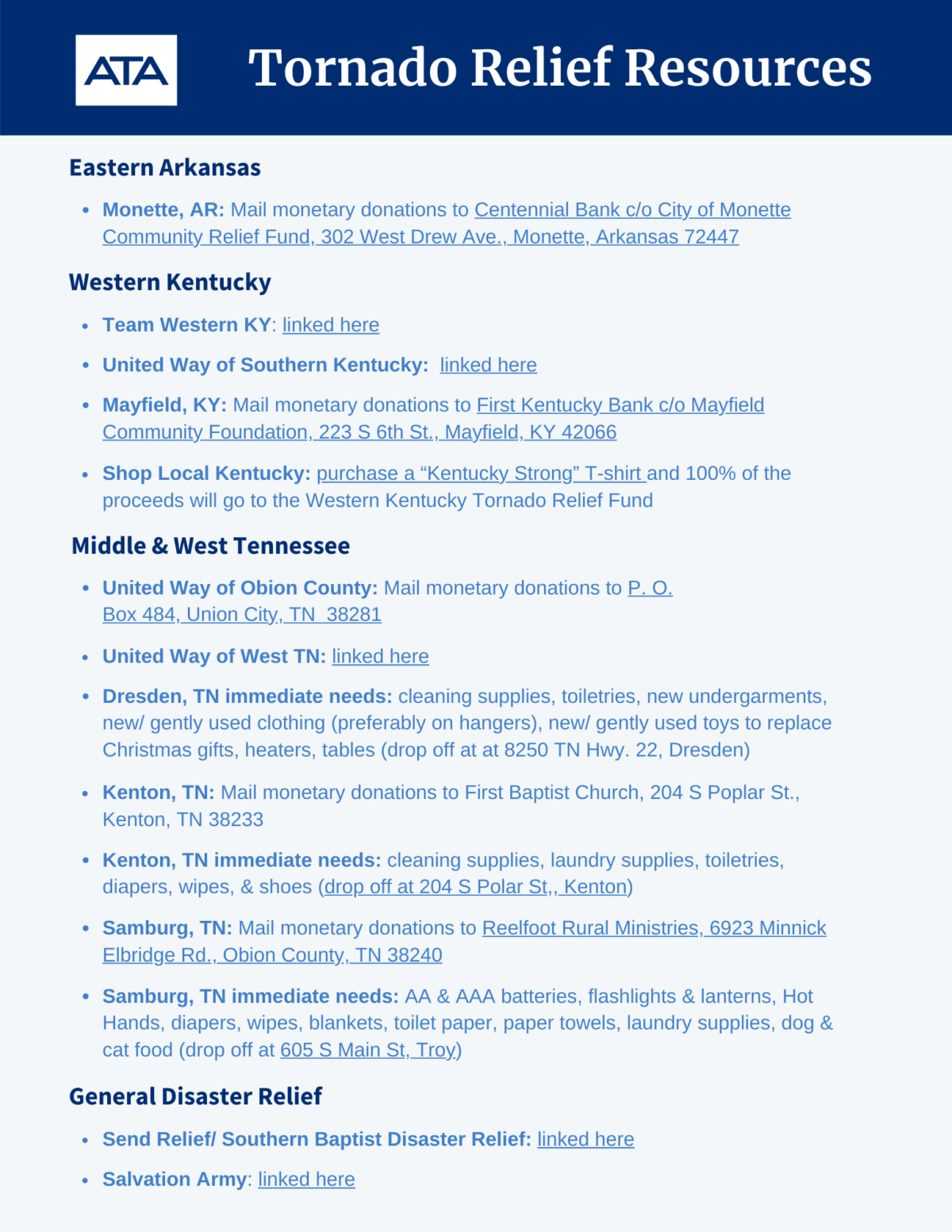
Tornado Relief Resources

Eastern Arkansas
Monette, AR: Mail monetary donations to Centennial Bank c/o City of Monette Community Relief Fund, 302 West Drew Ave., Monette, Arkansas 72447

Western Kentucky
United Way of Southern Kentucky

Team Western KY

Mayfield, KY: Mail monetary donations to First Kentucky Bank c/o Mayfield Community Foundation, 223 S 6th St., Mayfield, KY 42066

Shop Local Kentucky: purchase a “Kentucky Strong” T-shirt and 100% of the proceeds will go to the Western Kentucky Tornado Relief Fund

Middle & West Tennessee
United Way of West TN

United Way of Obion County: Mail monetary donations to P. O. Box 484, Union City, TN 38281

Samburg, TN: Mail monetary donations to Reelfoot Rural Ministries, 6923 Minnick Elbridge Rd., Obion County, TN 38240

Samburg, TN immediate needs: AA & AAA batteries, flashlights & lanterns, Hot Hands, diapers, wipes, blankets, toilet paper, paper towels, laundry supplies, dog & cat food (drop off at 605 S Main St, Troy)

Dresden, TN immediate needs: cleaning supplies, toiletries, new undergarments, new/ gently used clothing (preferably on hangers), new/ gently used toys to replace Christmas gifts, heaters, tables (drop off at at 8250 TN Hwy. 22, Dresden)

Kenton, TN: Mail monetary donations to First Baptist Church, 204 S Poplar St., Kenton, TN 38233

Kenton, TN immediate needs: cleaning supplies, laundry supplies, toiletries, diapers, wipes, & shoes (drop off at 204 S Polar St., Kenton)

General Disaster Relief
Send Relief/ Southern Baptist Disaster Relief

Salvation Army

Categories
Tax

Partnership and S Corporation Tax Planning

The Build Back Better Act contains various tax proposals that would affect partnerships, S corporations and their owners. Planning opportunities and other considerations for these taxpayers include the following:

  • Taxpayers with unused passive activity losses attributable to partnership or S corporation interests may want to consider disposing of the interest to utilize the loss in 2021.
  • Taxpayers other than corporations may be entitled to a deduction of up to 20% of their qualified business income (within certain limitations based on the taxpayer’s taxable income, whether the taxpayer is engaged in a service-type trade or business, the amount of W-2 wages paid by the business and the unadjusted basis of certain property held by the business). Planning opportunities may be available to maximize this deduction.
  • Certain requirements must be met for losses of pass-through entities to be deductible by a partner or S corporation shareholder. In addition, an individual’s excess business losses are subject to overall limitations. There may be steps that pass-through owners can take before the end of 2021 to maximize their loss deductions. The Build Back Better Act would make the excess business loss limitation permanent (the limitation is currently scheduled to expire for taxable years beginning on or after January 1, 2026) and change the manner in which the carryover of excess business losses may be used in subsequent years.
  • Under current rules, the abandonment or worthlessness of a partnership interest may generate an ordinary deduction (instead of a capital loss) in cases where no partnership liabilities are allocated to the interest. Under the Build Back Better Act, the abandonment or worthlessness of a partnership interest would generate a capital loss regardless of partnership liability allocations, effective for taxable years beginning after December 31, 2021. Taxpayers should consider an abandonment of a partnership interest in 2021 to be able to claim an ordinary deduction.
  • Following enactment of the TCJA, deductibility of expenses incurred by investment funds are treated as “investment expenses”—and therefore are limited at the individual investor level— if the fund does not operate an active trade or business (i.e., if the fund’s only activities are investment activities). To avoid the investment expense limitation, consideration should be given as to whether a particular fund’s activities are so closely connected to the operations of its portfolio companies that the fund itself should be viewed as operating an active trade or business.
  • Under current rules, gains allocated to carried interests in investment funds are treated as long-term capital gains only if the investment property has been held for more than three years. Investment funds should consider holding the property for more than three years prior to sale to qualify for reduced long-term capital gains rates. Although the Build Back Better Act currently does not propose changes to the carried interest rules, an earlier draft of the bill would have extended the current three-year property holding period to five years. Additionally, there are multiple bills in the Senate that, if enacted, would seek to tax all carry allocations at ordinary income rates.
  • Under the Build Back Better Act, essentially all pass-through income of high-income owners that is not subject to self-employment tax would be subject to the 3.8% Net Investment Income Tax (NIIT). This means that pass-through income and gains on sales of assets allocable to partnership and S corporation owners would incur NIIT, even if the owner actively participates in the business. Additionally, taxpayers that currently utilize a state law limited partnership to avoid self-employment taxes on the distributive shares of active “limited partners” would instead be subject to the 3.8% NIIT. If enacted, this proposal would be effective for taxable years beginning after December 31, 2021. Taxpayers should consider accelerating income and planned dispositions of business assets into 2021 to avoid the possible additional tax.
  • The Build Back Better Act proposes to modify the rules with respect to business interest expense incurred by partnerships and S corporations effective for taxable years beginning after December 31, 2022. Under the proposed bill, the Section 163(j) limitation with respect to business interest expense would be applied at the partner and S corporation shareholder level. Currently, the business interest expense limitation is applied at the entity level (also see Maximize interest expense deductions, above).
  • Various states have enacted PTE tax elections that seek a workaround to the federal personal income tax limitation on the deduction of state taxes for individual owners of pass-through entities.

For more guidance on tax planning for your S corp or partnership, contact one of our tax experts.

Categories
Helpful Articles Tax

Claiming Available Tax Credits for Businesses

The U.S. offers a variety of tax credits and other incentives to encourage employment and investment, often in targeted industries or areas such as innovation and technology, renewable energy and low-income or distressed communities. Many states and localities also offer tax incentives. Businesses should make sure they are claiming all available tax credits for 2021 and begin exploring new tax credit opportunities for 2022.

  • The Employee Retention Credit (ERC) is a refundable payroll tax credit for qualifying employers that have been significantly impacted by COVID-19. Employers that received a Paycheck Protection Program (PPP) loan can claim the ERC but the same wages cannot be used for both programs. The Infrastructure Investment and Jobs Act signed by President Biden on November 15, 2021, retroactively ends the ERC on September 30, 2021, for most employers.
  • Businesses that incur expenses related to qualified research and development (R&D) activities are eligible for the federal R&D credit.
  • Taxpayers that reinvest capital gains in Qualified Opportunity Zones may be able to defer the federal tax due on the capital gains. An additional 10% gain exclusion also may apply if the investment is made by December 31, 2021. The investment must be made within a certain period after the disposition giving rise to the gain.
  • The New Markets Tax Credit Program provides federally funded tax credits for approved investments in low-income communities that are made through certified “Community Development Entities.”
  • Other incentives for employers include the Work Opportunity Tax Credit, the Federal Empowerment Zone Credit, the Indian Employment Credit and credits for paid family and medical leave (FMLA).

There are several federal tax benefits available for investments to promote energy efficiency and sustainability initiatives. In addition, the Build Back Better Act proposes to extend and enhance certain green energy credits as well as introduce a variety of new incentives. The proposals also would introduce the ability for taxpayers to elect cash payments in lieu of certain credits and impose prevailing wage and apprenticeship requirements in the determination of certain credit amounts.

Categories
Helpful Articles Tax

Traditional vs Roth IRAs

People often ask, “Should I invest in a traditional or Roth IRA when planning for retirement? What’s the difference?” To answer this question, let’s discuss the basics.

Traditional vs. Roth

An IRA is an individual retirement account that is not associated with your employer. When opening an IRA, you will have to choose either traditional or Roth. This is not to say that you are limited to one account for your lifespan. Depending on your income and the stage of your career, both types can be beneficial. 

Generally, Roth IRAs are best suited for younger individuals because they have a long working life before they retire, and that large time-frame gives their investments time to increase substantially. This increase will not be taxable when drawn out during retirement. Roth IRAs also come with an income limit, so it is ideal for those at entry-level or mid-level in their careers.

Traditional IRAs are best suited to those who are in a higher tax bracket. These individuals will save significant tax dollars immediately through tax-deductible contributions and will likely be in a lower tax bracket when they retire because their income will be reduced. This usually describes mature individuals who are in their later years of working and usually have higher incomes. Therefore, the tax savings now are greater, and the time for investments to increase in value is shorter. 

Withdrawing Your Savings

When you decide to put money in a retirement account, it is ideal to leave that investment untouched until you are retired. Traditional IRAs have stricter rules about early withdrawals than Roth accounts. The penalty for early withdrawal (before age 59.5) from a Traditional IRA is 10%, and you pay income tax on the amount you withdraw. Roth IRA withdrawals are tax and penalty free if you withdraw upon reaching age 59.5 and the account has been established for five or more years.

Traditional IRAs impose Required Minimum Distributions (RMDs) when you turn 72; this is a minimum amount that you must withdraw each year from your account. These withdrawals are considered taxable income. To find your RMD, use this worksheet from the IRS.

Roth IRAs do not impose RMDs, and the withdrawals are not considered taxable income. 

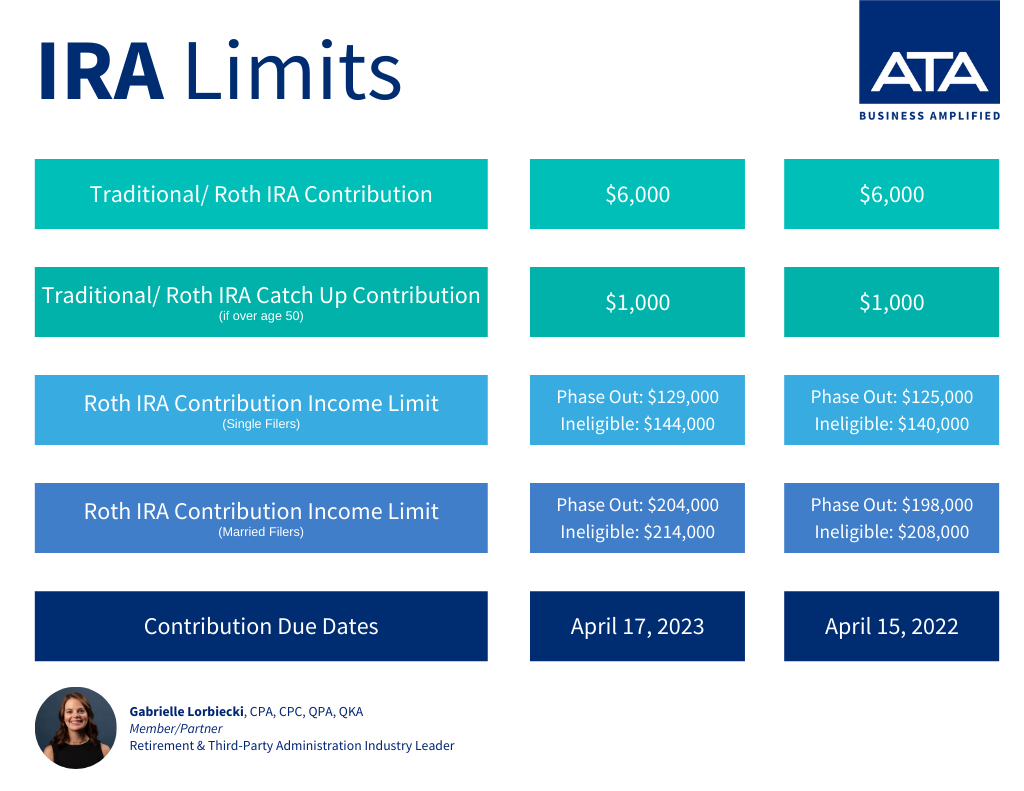
Both Traditional and Roth IRAs have contribution limits and due dates that vary year-to-year. You can find those amounts and dates in the graphic below.

For more information and consultation about IRAs and retirement planning, contact industry leader Gabrielle Lorbiecki or visit https://atacpa.net/ata-retirement.

Categories
Tax

What Can Be Written Off as a Business Expense? 

Watch the tax planning video on small business expenses here.

Your business expenses can translate into tax write-offs, also known as deductions, as long as they’re “ordinary and necessary“—that is, common in your industry and essential to your business. When an expense meets those requirements for your business, you can deduct it.

Some of these include:

  • Internet Expenses
  • Office space 
  • And payment to employees

We hear many business owners wanting clarification on office space, including home offices, as well as business meal expenses.

Overlapping company and personal expenses 

Sometimes an expense can be broken down between your business and your personal life. For example, if you use part of your home as your office and use that area solely for business purposes, then you can make a home office deduction. The standard method of deducting home office expenses involves calculating the percentage of your home that is used for business by taking the square footage of your office area and dividing it by the total square footage of  your home.

Let’s say your office is 5% of your home’s square footage, so you can deduct 5% of the cost of your mortgage interest, utilities, insurance and other related expenses at tax time.

You can apply a similar model to the times you use your personal vehicle for business, by keeping track of miles driven and deducting based on the IRS’s standard mileage rate.  

Common Non-Deductible Business Expenses

Some costs related to doing business cannot be deducted from your taxable income. Common examples include lobbying or political costs and penalties/fines. Additionally, entertainment costs such as tickets to a sporting event cannot be expensed. Prior to this year, only 50% of business meals were deductible. As part of the Consolidated Appropriations Act (2021), the deductibility of business meals is changing. Food and beverages will be 100% deductible if purchased from a restaurant in 2021 and 2022. This temporary 100% deduction was designed to help restaurants, many of which have been hard-hit by the COVID-19 pandemic.

The first thing you should do to help keep track of your small business expenses is to open separate business checking and savings accounts for your business. After that, ensure that you’re also keeping your business expenses separate from your personal expenses.

Small businesses contribute to local economies by bringing growth and innovation to the community. ATA walks alongside business owners to help overcome challenges in an efficient and experienced manner. To discuss business expenses in depth, contact one of our experts for a consultation.